
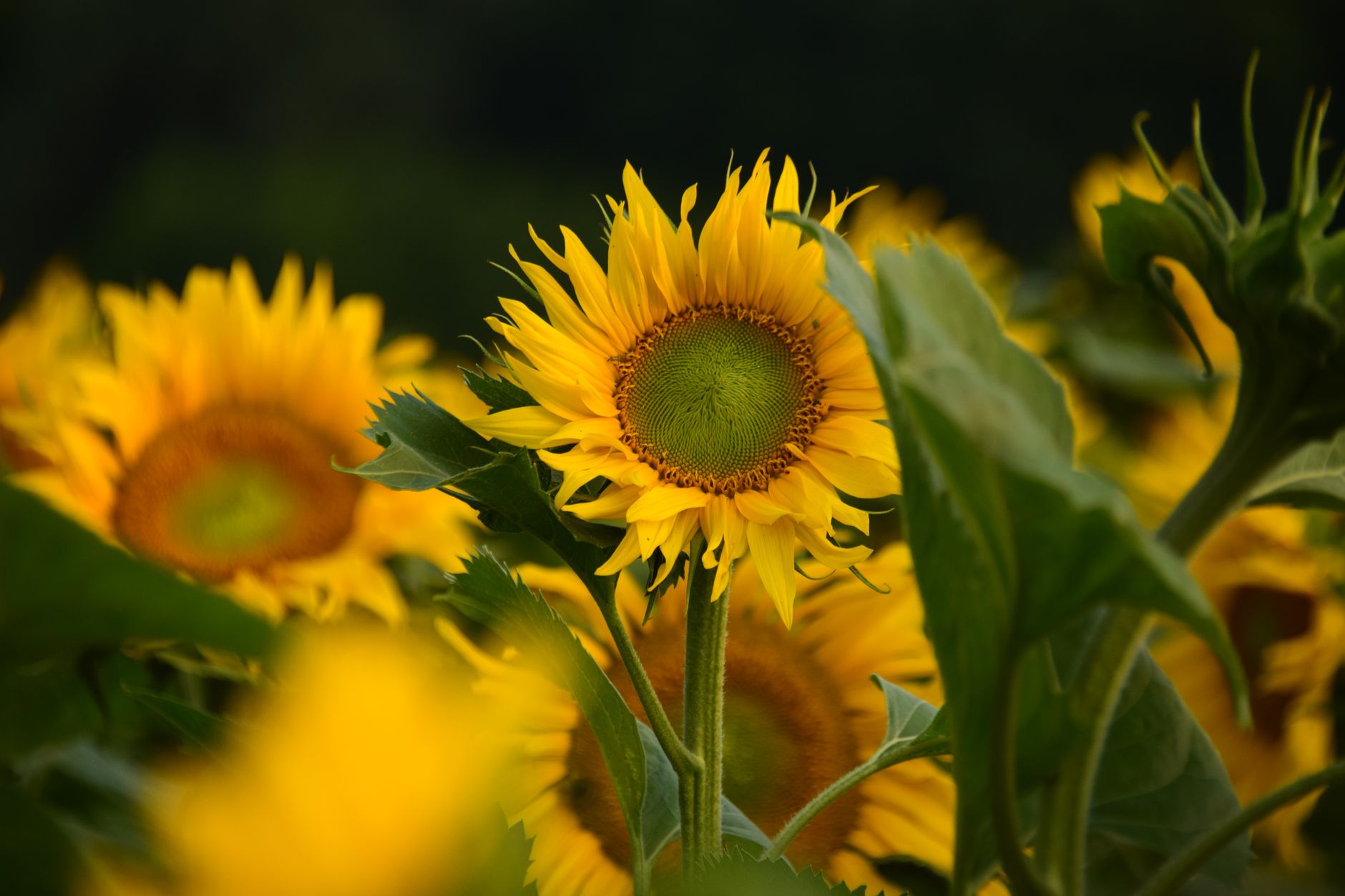
There is no flower on Earth that produces a more immediate, more universal, more involuntary smile than a sunflower. None. Roses are romantic. Lilies are elegant. Peonies are lush. But sunflowers are happy — unambiguously, uncomplicated, cannot-be-misinterpreted happy. They walk through the door and the room changes.
We work with every flower in the catalog. We appreciate them all. But sunflowers hold a special place because of what they do to people. Nobody has ever received a sunflower arrangement and felt uncertain about what it meant. It meant: I want you to smile.
Here is everything we know about them.
☀️ Why They Follow the Sun (and Then Stop)
Young sunflowers do something remarkable: they track the sun across the sky. In the morning, the stem faces east toward the sunrise. Throughout the day, it slowly turns to follow the sun westward. At night, it resets back to the east. This is called heliotropism, and it is one of the most visually dramatic plant behaviors in nature.
The mechanism is elegant. The east side of the stem grows faster during the day, which pushes the flower head westward toward the sun. At night, the west side grows faster, resetting the head back to the east. It is not the flower “deciding” to face the sun — it is differential growth rates on opposite sides of the stem, regulated by the plant’s internal clock and auxin hormones.
Here is the part most people do not know: mature sunflowers stop tracking. Once the flower head fully opens and the stem stiffens, the sunflower settles into a permanent east-facing position. It no longer follows the sun. Scientists believe the east-facing orientation warms the flower head faster in the morning, which attracts more pollinators — bees prefer warm flowers.
So the lifecycle of a sunflower is: restless youth spent chasing the sun, followed by a mature adulthood of facing east and letting the world come to you. There is probably a metaphor in there somewhere.
💐 Varieties Your Florist Actually Uses
When most people think of sunflowers, they picture the giant backyard kind — 8 feet tall, a single massive head, planted in a row along a fence. Those are beautiful in a garden. They are terrible in a vase. The stem is too thick, the head is too heavy, and they do not fit in any arrangement.
Florist sunflowers are bred specifically for cut-flower use. They are shorter-stemmed, proportionally sized, and — crucially — many are pollenless. Here are the varieties we work with most:
- Sunrich: The industry standard. Clean, bright yellow petals with a dark center. Pollenless. Excellent vase life. This is probably the sunflower in 80% of the arrangements you have seen.
- ProCut series: A family of varieties bred for professional floristry. ProCut Gold, ProCut Orange, ProCut Bicolor. Consistent, reliable, available year-round from major growers.
- Vincent’s Choice: A multi-branching variety that produces several smaller heads per stem. More natural, less “single specimen” than Sunrich. Popular for wildflower-style and garden-style arrangements.
- Teddy Bear: A fully double sunflower — all petals, no visible center disk. It looks like a fluffy golden pom-pom. Charming, unusual, and a conversation starter.
- Italian White: Cream to pale yellow petals with a dark center. Elegant and unexpected. People do not expect a sunflower to be white, which makes it memorable.
- Moulin Rouge / ProCut Red: Deep burgundy-red petals. Dramatic, moody, and nothing like the classic sunny yellow. Red sunflowers are stunning in autumn arrangements and in mixed designs where you want warmth without brightness.
- Ring of Fire: Bicolor — red center petals fading to golden tips. One of the most dramatic sunflower varieties in existence.
🎨 Colors Beyond Yellow
Most people think sunflowers are yellow. Sunflowers come in:
- Classic golden yellow — the iconic color
- Lemon yellow — lighter, softer, pairs beautifully with white and cream
- Orange — warm, autumnal, pairs with burgundy and rust
- Red and burgundy — deep, dramatic, unlike anything people expect from a sunflower
- Chocolate and bronze — rich, earthy tones that work in fall and rustic designs
- Bicolor — two-toned petals with color gradients from center to tip
- Cream and white — subtle, sophisticated, and surprisingly elegant
When you ask your florist for sunflowers, tell us which mood you want. Classic cheerful? Golden yellow. Sophisticated and unusual? Italian White or a bicolor. Rich and dramatic? Moulin Rouge. The sunflower family is broader than most people realize, and the right variety can fit almost any aesthetic.
🌾 Pollenless vs. Garden Sunflowers: Why It Matters
This is the single most important thing to know about sunflowers in arrangements:
Pollenless varieties exist, and they are what florists use. Standard garden sunflowers produce copious pollen — the golden dust that covers the center disk. That pollen falls onto tables, stains tablecloths, stains clothing, stains skin, and creates a mess. In a garden, pollen is the point (it feeds bees). In a vase on your dining table, pollen is a problem.
Pollenless sunflower varieties were developed specifically for the cut-flower industry. They have the same look, the same size, the same cheerful face — but with no pollen production. No dust. No staining. No mess. When you order sunflowers from a florist, you are almost certainly getting pollenless stems.
If you grow sunflowers in your own garden and cut them for the house, you may encounter pollen. The solution: gently brush the center disk with a dry paper towel to remove loose pollen before bringing them inside, or choose pollenless varieties for your cutting garden.
⏱️ How Long Sunflowers Last in a Vase
Sunflowers are excellent cut flowers with a vase life of 7–12 days when properly cared for. That is longer than most people expect. Here is how to get the most out of them:
- Cut stems at a 45-degree angle before placing in water. Re-cut every 2–3 days.
- Strip all leaves below the waterline. Sunflower leaves decompose quickly in water and create bacteria that shortens vase life. Remove them ruthlessly.
- Change the water every 2 days. Sunflowers are heavy drinkers. They consume more water than most cut flowers. Check the water level daily — a large sunflower can drink a surprising amount overnight.
- Use flower food. The packets we include with every arrangement actually work. They contain sugar (food), acidifier (keeps water pH optimal), and biocide (kills bacteria).
- Keep them out of direct sunlight. Yes, this is ironic. The flower that loves the sun in the field will wilt faster in a vase if placed in direct sun. Indirect light, room temperature.
- Use a tall, heavy vase. Sunflower heads are heavy. A short, light vase will tip over. Use something with a wide base and enough height to support the stems. Weighted ceramic or thick glass works best.
📛 The Stages of a Sunflower’s Vase Life
Sunflowers change character as they age in a vase, and every stage is beautiful:
- Days 1–3: Fresh, tight, petals crisp and upright. The classic sunflower look. Peak photo opportunity.
- Days 4–7: Petals relax and splay outward. The face opens fully. The flower looks mature, warm, and generous. Many people prefer this stage.
- Days 8–12: Petals begin to droop slightly. The center disk becomes more prominent. The flower takes on a rustic, late-summer character. Still beautiful. Still worth keeping.
💛 When to Send Sunflowers
Sunflowers are the most versatile occasion flower in our cooler. They work for almost everything:
- Birthday: Always. Every age. Every person. Nobody is unhappy to receive sunflowers on their birthday.
- Congratulations: Promotions, new jobs, graduations, milestones. Sunflowers are inherently celebratory.
- Get well: Cheerful, bright, and scientifically proven to improve mood. Sunflowers in a hospital room or a home recovery space make a measurable difference.
- Thank you: Warm, appreciative, and not overly formal. The perfect thank-you flower.
- Just because: The best “just because” flower. No subtext. No ambiguity. Pure joy.
- Father’s Day: The number one dad-friendly flower. Bold, warm, unpretentious.
- Housewarming: A sunflower arrangement is the ultimate “welcome to your new place” gift.
- Game day: Green and yellow? Sunflowers are already half the palette.
The one occasion where sunflowers do not typically fit: formal sympathy arrangements. The cheerful energy of a sunflower can feel dissonant at a funeral or memorial. There are exceptions — if the deceased loved sunflowers, they are absolutely appropriate as a personal tribute. But for a default sympathy arrangement, roses, lilies, and chrysanthemums are more traditional.
🏠 Sunflowers at Home: Practical Notes
- They need space. Sunflowers have large heads and stiff stems. They do not cram well into small, tight arrangements. Give them room to breathe.
- A single sunflower in a bud vase is a statement. You do not need a dozen. One sunflower, one simple vase, one spot in the kitchen where the light hits it — that is enough.
- They pair beautifully with almost everything: roses, eucalyptus, snapdragons, daisies, greenery, wildflowers. Sunflowers are the anchor of a mixed arrangement — they provide the focal point and everything else supports them.
- They dry well. If you hang sunflowers upside down in a dry, dark space for 2–3 weeks, they dry into a rustic, preserved version that lasts indefinitely. The petals darken and the center disk becomes textured and sculptural. Dried sunflowers in a vase are a year-round reminder of summer.
🌿 Why Sunflowers Are the Flower of Optimism
There is a reason sunflowers show up in art, in decoration, in emoji, in every cheerful context humans have invented. They are structurally optimistic. The face is open, broad, and upward-looking. The color is warm. The size is generous. Everything about a sunflower’s design communicates abundance, warmth, and welcome.
Van Gogh painted them when he wanted to capture joy and friendship. Ukrainian culture adopted them as a national symbol of resilience and warmth. Children draw them first when asked to draw a flower. There is something embedded in the sunflower’s form that speaks to the human brain at a level deeper than aesthetics. They look like the sun. They look like a face. They look like they are glad to see you.
We sell a lot of sunflowers. We will never get tired of them. Every time we put one in an arrangement, we think: whoever receives this is going to smile. And we are always right. 🌻
Browse our arrangements, plants, and gifts. Same-day delivery available. Ask for sunflowers by name — or tell us “something cheerful” and we will probably reach for them first.