
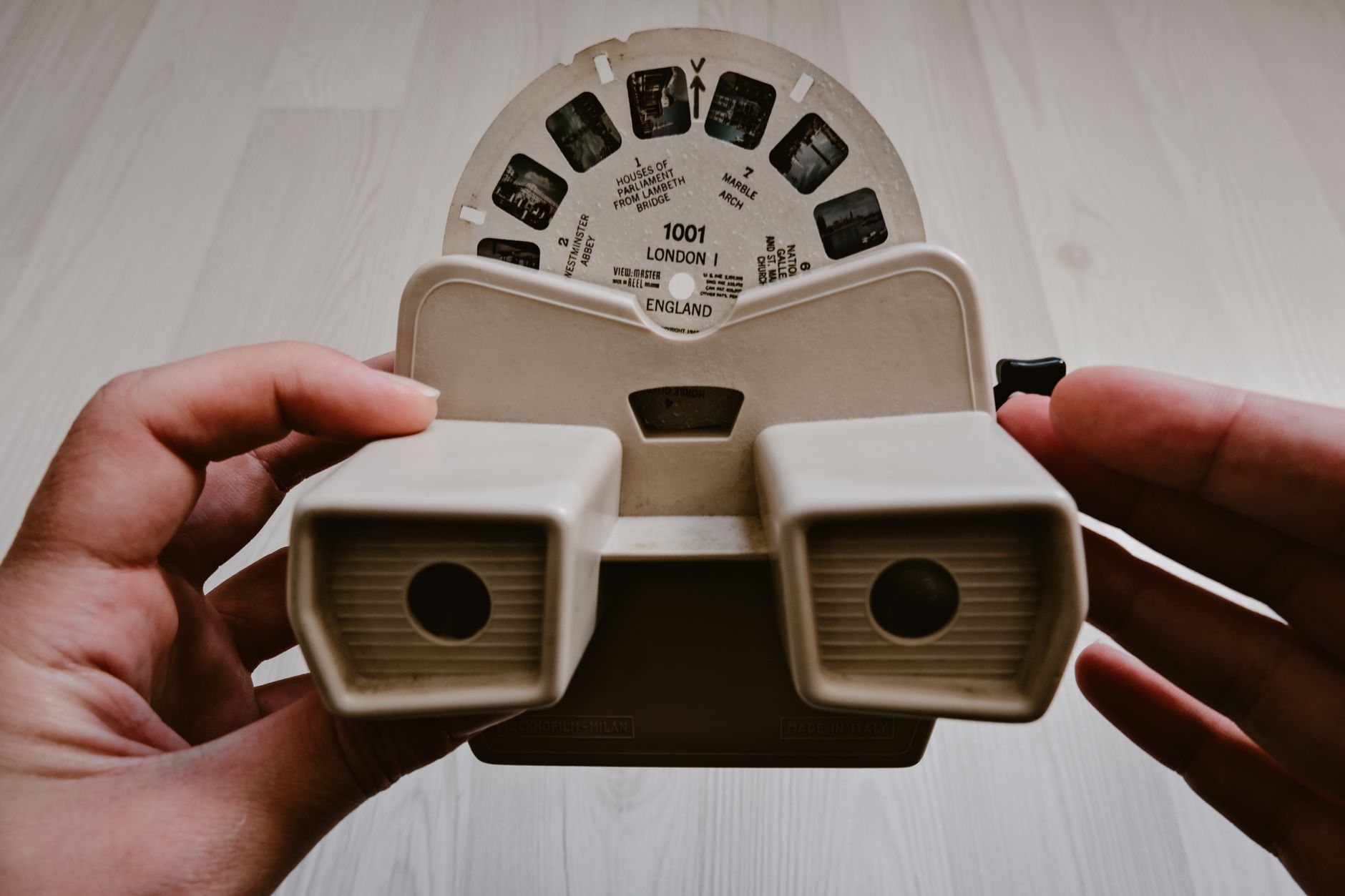
If you grew up anywhere near Tigard, there is a fair chance you have a story about a View-Master. Click, and the picture changes. Click again, and you are standing at the Grand Canyon in full color and, somehow, in three dimensions. What many people here do not know is that the toy in the red viewer was a local product. It was dreamed up by a Portland photographer, and for decades it was made at a factory on the edge of Tigard.
💡 A Portland Idea From 1938
The story begins with William Gruber, a Portland photographer and player-piano technician. He rigged two cameras together on a tripod to take paired photographs, and he had the idea of mounting tiny pieces of the new Kodachrome color film on a round disk of the heavy paper used for player-piano rolls. A special viewer would show each pair of pictures as one image in 3D. In 1938 he met Harold Graves of Sawyer’s, the Portland photo-finishing company, and the two began working on what became the View-Master.
Each disk, called a reel, holds seven pairs of tiny color pictures. The system was introduced at the 1939 New York World’s Fair as an alternative to the scenic postcard, and the first reels showed places such as Carlsbad Caverns and the Grand Canyon. Over the years the company made more than 4,300 different reels, and the View-Master name became known to most of the world.
🏭 The Factory at Progress
In 1951, Sawyer’s opened a factory in Progress, Oregon, to make the viewers and reels. Progress is the crossroads community at Scholls Ferry Road and Hall Boulevard, and today it is split between the cities of Tigard and Beaverton. Written accounts place the plant in Beaverton, but it stood right at our boundary, and a lot of Tigard families will tell you someone they knew worked there.
At its peak in the mid-1970s the plant employed up to 2,000 people. By 2000, when the owner at that time, Mattel, announced it would move production to Tijuana, Mexico, the workforce was down to about 60. The factory closed in 2001. The site was later redeveloped as a shopping plaza, so the best place to see the old View-Master world now is a thrift store shelf or a box in somebody’s attic.
🌹 Why It Still Makes People Smile
A View-Master is a small thing, and that is part of the charm. It asks you to hold something up to the light and look closely, and nearly everyone who tried one remembers where they were. That is the same feeling a bouquet gives, which is why a florist keeps meeting people who say “this reminds me of…”. Memory and flowers get along well.
If the story brought someone to mind, here are a few ways to turn it into a gift:
- A bouquet for a parent or grandparent who still has the viewer and a stack of reels
- A small arrangement for a friend who worked at the plant, with a note that says “I thought of you”
- Flowers for a birthday, with a vintage toy or two beside the vase for the table
- A bouquet to say thank you to the person who always had a story from the old days
For more Tigard history, read our look at how Tigard grew from onion fields to a suburb, or our local guide to Washington Square, which sits in the same corner of town.